Background
PUBS is a rarely described entity characterized by a purple discoloration of the urine, most commonly in elderly patients with indwelling Foley catheters. Other risk factors may include chronic debilitation, dementia, female gender, and alkaline urine. The phenomenon is less commonly observed in patients with percutaneous drains or in the absence of catheters.1 While the finding is thought to be benign, it is important to recognize, as it can understandably cause concern amongst patients and health care workers alike, and may lead to unnecessary workup and treatment. We describe a middle-aged male who presented with an indwelling Foley catheter and percutaneous nephrostomy tube with purple urine in the bag.
Case Presentation
A 66-year-old male patient with a history of atrial fibrillation, treated hepatitis C, essential hypertension, and stage IIIB rectal adenocarcinoma status post neoadjuvant chemotherapy and radiation. The patient additionally had a complex surgical history including low anterior resection surgery for his rectal adenocarcinoma which resulted in multiple post-operative complications, including a bladder and ureteral injury ultimately requiring repair and a left percutaneous nephrostomy tube placement in addition to an indwelling Foley catheter. Approximately one month after his nephrostomy tube and Foley catheter placement, the patient presented to the emergency department from home after developing sudden onset of penile pain after reporting Foley catheter trauma while taking a shower.
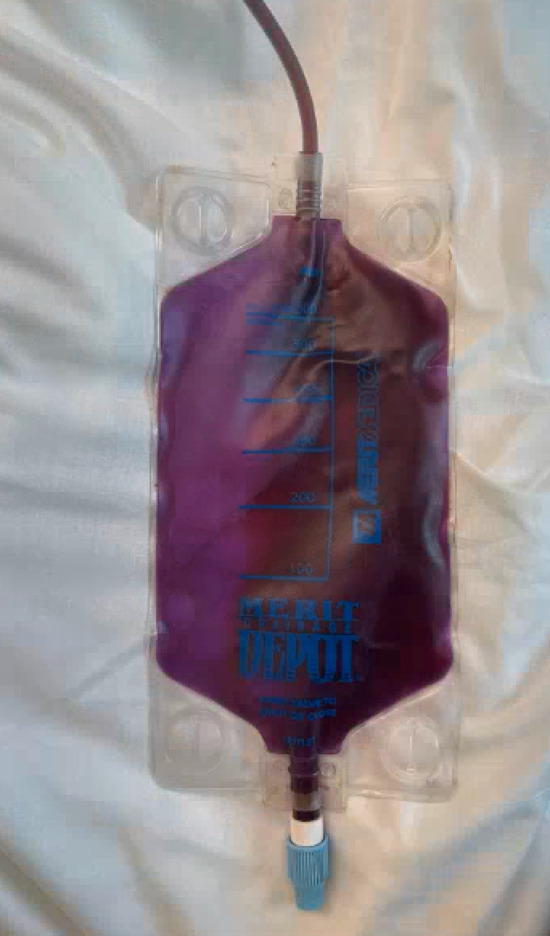
On presentation, the patient had a temperature of 97.4 degrees Fahrenheit, heart rate of 120 beats per minute, respiratory rate of 18 breaths per minute, and a blood pressure of 133/77 mmHg. He appeared comfortable with normal lung sounds and a soft non-tender abdomen. The exam was notable for a left percutaneous nephrostomy tube in place with mild tenderness around the insertion site and purple urine draining into the collection bag (Figure 1). The Foley catheter was noted to be in place and draining yellow urine without discoloration.

His pertinent lab data on admission included a normal white blood cell count of 9,000 cells/uL with a normal differential, a hemoglobin of 12.6 g/dL, and hematocrit of 40.5 g/dL. His renal function was normal with a BUN of 13.0 mg/dL and creatinine of 0.84 mg/dL. Urinalysis was notable for turbid appearing urine, 500/uL leukocyte esterase, nitrate negative, 100 mg/dL protein, >100/HPF red blood cells, >100/HPF white blood cells, and 0 squamous epithelial cells. An EKG was obtained and confirmed sinus tachycardia. Computed tomography urogram with and without contrast showed a left percutaneous nephrostomy tube in place, a rim-enhancing fluid collection with air within the retroperitoneum measuring 3.4cm, as well as a double-J stent within the left renal pelvis terminating in the bladder with surrounding fat stranding within the pelvis. Computed tomography cystogram showed leak of instilled contrast from the posterior bladder dome into an elongated presacral collection.
The Foley catheter was replaced by the emergency department. The patient was admitted to the hospital and initiated on broad-spectrum antibiotics including vancomycin and piperacillin-tazobactam. Urology was consulted and recommended to keep the Foley catheter in place, given a fistula between the bladder and presacral space. Urine culture ultimately grew greater than 100,000 colony forming units of pan-sensitive Klebsiella pneumonia, Proteus mirabilis and Enterococcus gallinarum. Infectious Diseases was consulted, and recommended against treatment for urinary tract infection, given the lack of symptoms and resolution of penile pain after the Foley catheter was replaced. Antibiotics were thus discontinued on day 2 of hospitalization. The left nephrostomy tube continued to drain purple urine, which was attributed to purple urine bag syndrome, given the presence of bacterial colonization of the catheter. He was discharged home with plan for outpatient clinic follow-up and re-imaging in the outpatient setting.
Discussion
Purple Urine Bag Syndrome (PUBS) is a rarely encountered clinical entity in which the urine develops a purple hue, typically in response to a urinary tract infection or bacterial colonization in patients with indwelling catheters, and rarely reported in patients with percutaneous nephrostomy tubes.1 It was first described in the literature in 1978, however the true incidence remains unknown.2 It has been suggested that the phenomenon is initiated when tryptophan from food is metabolized by gut bacteria to produce indole, which is further metabolized by the liver, and through interactions with urinary bacteria and alkaline urine eventually form indicans (indigo and indirubin). These indicans, through further interaction with the plastic material of the catheter bag and tubing, are thought to be responsible for the purple discoloration of the urine.3
The causative factors of PUBS have not been definitively established. It is most commonly linked with elderly patients and those with dementia who require chronic indwelling urinary catheterization.4 Occurrences of PUBS associated with percutaneous nephrostomy tubes are described much less commonly.5 Additionally, there have been reported cases of similar findings of purple colored urine in patients lacking a urinary catheter.6 These usually involve elderly patients with chronic constipation and laxative use. Some of the most commonly implicated urinary tract bacteria in PUBS are Providencia stuartti, Proteus mirabilis, Pseudomonas auruginosa, Klebsiella pneumoniae, Escherichia coli, Morganella species, Enterococci and Group B Streptococci.1 However, a case control study by Mantani et al. failed to identify a correlation between a specific bacterial strain and the incidence of PUBS.7 Instead it was noted that elevated bacterial counts, particularly counts > 105 cfu/ml, were seen in most urine samples in patients with PUBS, suggesting that higher bacterial yield in the urine may be the most important risk factor.7 Additionally, a higher incidence of the syndrome was noted in female patients and patients producing a more alkaline urine.7 Our patient grew multiple implicated organisms, including Klebsiella pneumonia, Proteus mirabilis and Enterococcus gallinarum.
PUBS is generally thought to be a benign entity that does not require specific treatment.8 While PUBS may indicate the presence of bacteria in the urine, it is not alone diagnostic of a urinary tract infection. The urine discoloration typically resolves after treatment of the urinary bacteria and/or exchange of the urinary catheter and collecting bag.8 The entity of PUBS alone is not an indication to treat with antibiotics and instead the patient should be screened for symptoms indicative of a urinary tract infection as per usual. It is important for providers to be aware of this clinical entity and its meaning in order to avoid unnecessary testing or further workup, while reassuring the patient, family members, and other members of the medical treatment team.
In summary, PUBS is likely suggestive of high bacterial counts, which can represent colonization or acute urinary tract infection. The finding of PUBS alone is not necessarily indicative of an acute urinary tract infection, and patients should be screened for typical symptoms prior to treatment with antibiotics. The urine typically clears with the exchange of the catheter and/or treatment with antibiotics. Patients and families should be reassured that the urine discoloration, while striking, is generally a benign finding.
Disclosures/Conflicts of Interest
None
Corresponding author
Shane Guillory, MD
Department of Internal Medicine,
Louisiana State University Health Sciences Center, New Orleans
Email: sguil1@lsuhsc.edu