I sat beside my patient days before Christmas. He had been hospitalized for weeks, his life pressor-dependent, his kidneys failing, and he was becoming increasingly somnolent. He had experienced the full gamut of modern medical offerings: intubation, central lines, arterial lines, countless Computed Tomography (CT) scans, Magnetic Resonance Imaging (MRI), Transthoracic Echocardiograms (TTE), and an Electroencephalogram (EEG), to list a few. With each order I placed, lab we drew, or additional test we performed, I felt an escalating guilt; a sense of a deepening discordance between our aggressive care and what was best for the patient. For weeks, the medical team had discussed the next steps in the escalation of his care including dialysis, re-intubation, and Cardiopulmonary Resuscitation (CPR), still covering only a portion of the breadth of testing and interventions the hospital can inflict. I had become familiar with his son and daughter, who had spent weeks at his bedside providing comfort and presence. While I had only been his provider for a fraction of his time in the hospital, I attempted, as all my colleagues had since his admission weeks prior, to clarify his goals of care under pressing necessity.
“If your heart were to stop, or you couldn’t breathe on your own, would you want us to perform CPR and put a tube in your throat?” Despite my best efforts during residency, the sheer volume of admissions had restricted my time at the bedside, leading to unintentionally cursory discussions regarding complex medical interventions. I had developed through repetition what I thought was the best way to check the box of “code status” before the morning light crept up the halls. My efforts, despite being well-intentioned, were ineffectual, and I knew it.
These therapeutic crossroads are where goals of care conversations routinely fail.1 Hospitalized patients frequently undergo invasive interventions incongruent with their interests, despite the altruistic intentions of providers. Across training programs and hospital wards, frontline clinicians intimately understand the distress produced by the friction between the treatments we order and the elusive goals of patients. This predictable dyssynchrony arises within a system designed to administer increasingly invasive and burdensome care - such as arterial lines, dialysis, tracheostomies, and advanced surgical procedures - in the name of life preservation.
Constructing subjective values into clinical preferences remains profoundly difficult.2 Commonly, patients lack the impetus to discuss their goals of care with family or providers before a medical crisis. Even when Treatment Escalation Plans (TEPs), living wills, or other planning documents are filled out, they still may not produce congruence between goals and medical care.3 While these plans can be completed upon hospital admission, doing so requires significant time and effort to discuss and implement, making their completion often unfeasible acutely. Even in ideal circumstances, clinicians who value these conversations face barriers such as patient reticence to discuss end of life topics, provider discomfort, time pressures, acute illness, and insufficient training.4
Unfortunately, the burden falls on the acute care provider to quickly identify patient goals and efficiently tailor medical options. While limited time and resources necessitate a rapid investigation, reducing the vast array of medical interventions to a strict binary choice sacrifices nuance. This all-or-nothing choice fails to respect the complexity of patient values, inadvertently limiting patient autonomy. A different framework allowing patients to express their preferences along a continuum of intensity may be uniquely beneficial.
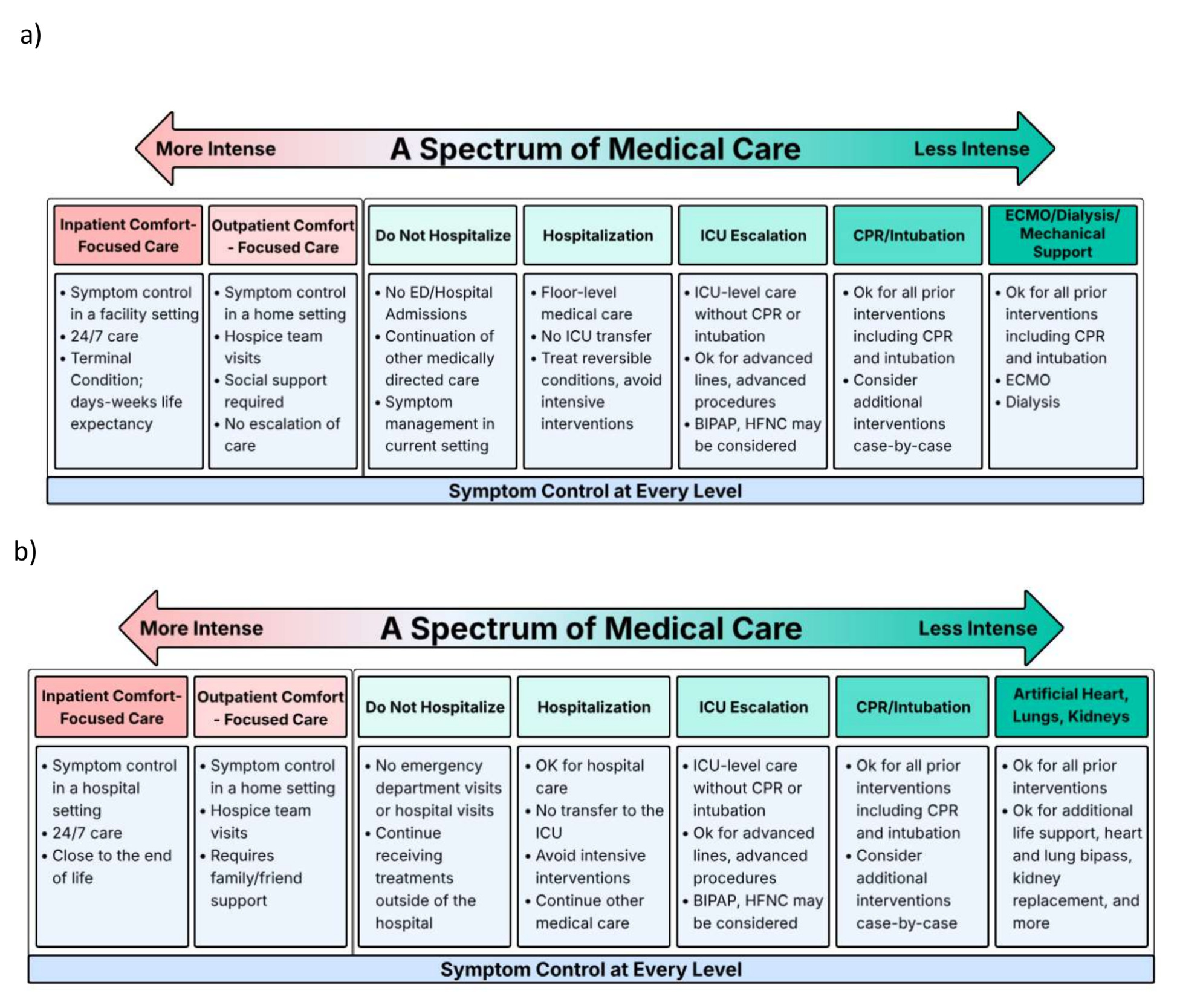
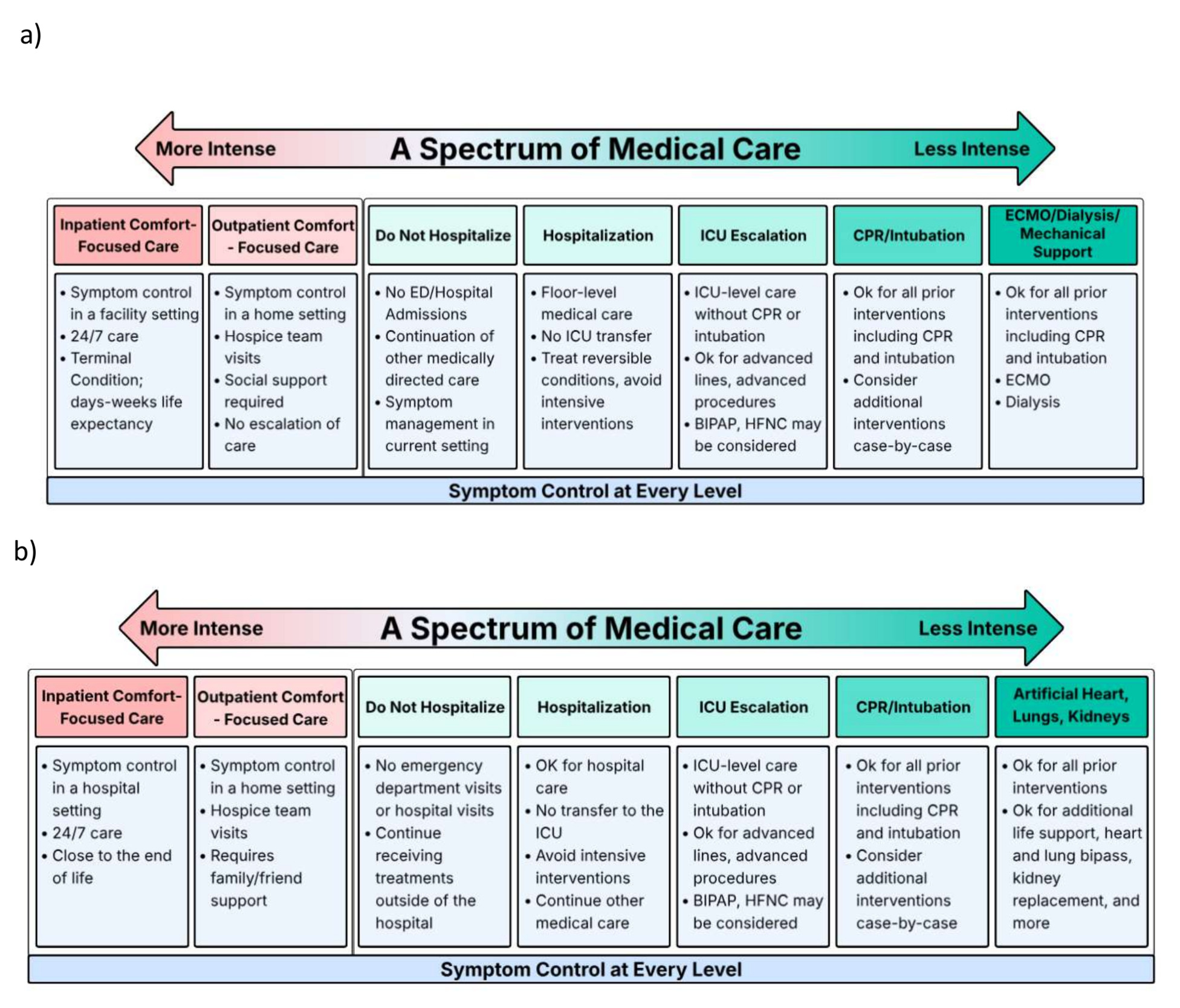
How then can providers quickly establish goals and narrow medical treatments without resorting to binary ultimatums in the acute setting? Eliciting a patient’s core values, both within and outside the context of illness, must be the determining factor in guiding care. Once these goals are identified, clinicians can help patients identify which level of intervention is most congruent with their values and goals (Figure 1).5 Similar structured guides, such as the Serious Illness Care Program through Stanford Medicine, critically emphasize the alignment of medical care and the goals of patients.6 However, a unique emphasis on the increased burden of care with escalating interventions may be additionally helpful in guiding patients. Importantly, symptom control must be prioritized throughout the spectrum of care, not only when life-prolonging treatments are limited. Finally, in patients with particularly burdensome illness, early goals of care conversations, and importantly palliative care involvement, may provide not only a benefit for quality of life but also improve lifespan.7
It can be argued that transitioning to a broader framework places unsustainable stress on already burdened providers and the medical system. However, continuing to present options as a blunt binary choice all but guarantees confusion and discordance when a patient’s health inevitably deteriorates. Paradoxically, making a medical recommendation utilizing a spectrum-based approach is likely to streamline subsequent conversations and enhance a patient’s understanding of clinical options early in a hospitalization. Even if this framework requires a shift in initial communication efforts, empowering patients to confidently decline invasive, high-cost, intensive interventions would provide meaningful relief to patients, families, providers, and the healthcare system alike. Lastly, while some resources share a similar approach to these conversations, a focus on the escalation of intensity and burdens of medical care may help patients make decisions that are more congruent with their goals.
Christmas morning inevitably came, and I found my patient sharing a moment with his family at the bedside. He was minimally responsive, eyes closed; his son motioned to me to speak outside the room. The pressors were discontinued later that morning. He died shortly after, with his son and daughter by his side. The family thanked us. He had ultimately been able to fulfill his most critical wish of spending one more holiday with his children. Yet, I still wonder if we had asked the right questions earlier, whether he could have avoided the tests, blood draws, and procedures that had ultimately limited their final time together.
Disclosures/Conflicts of Interest
None
Corresponding Author
Justin Halterman
Internal Medicine Residency
Rhode Island Hospital
593 Eddy Street, Providence, RI 02903
Email: Justinphalterman@gmail.com