Background
Citing concern for absorption of Direct Oral Anticoagulants (DOACs), warfarin has traditionally been seen as the safest option for anticoagulation after bariatric surgery.1,2 Although high-quality randomized controlled trial (RCT) data are lacking, cohort studies and case reports have demonstrated adequate DOAC absorption, supporting their potential efficacy and possibly lower bleeding risk compared with warfarin.3–6 We report a case demonstrating therapeutic absorption of apixaban despite severe, chronic malabsorption following bariatric surgery.
Case Presentation
A 44-year-old woman presented to the emergency department with several months of progressive bilateral lower extremity edema, fatigue, nonspecific pain, and declining functional capacity. Her symptoms acutely worsened following a brief COVID-19 infection several months earlier, followed by the subacute development of hematuria, loose and pale-colored stools, new rashes, and brittle, cracking nails and fingertips. Her medical history was notable for hemolytic uremic syndrome requiring a brief period of dialysis, persistent moderate proteinuria, Lynch syndrome, class 1 obesity (previously class 3) following Roux-en-Y gastric bypass 17 years earlier complicated by chronic malabsorption, fibromyalgia, opioid use disorder, and prior pulmonary embolism and deep vein thrombosis. The thromboembolic events were unprovoked, with no identified reversible risk factors, and she was therefore maintained on warfarin. Her other home medications included sublingual buprenorphine-naloxone, oral cyanocobalamin (vitamin B12), amlodipine, duloxetine, and pregabalin. She was not taking a multivitamin.
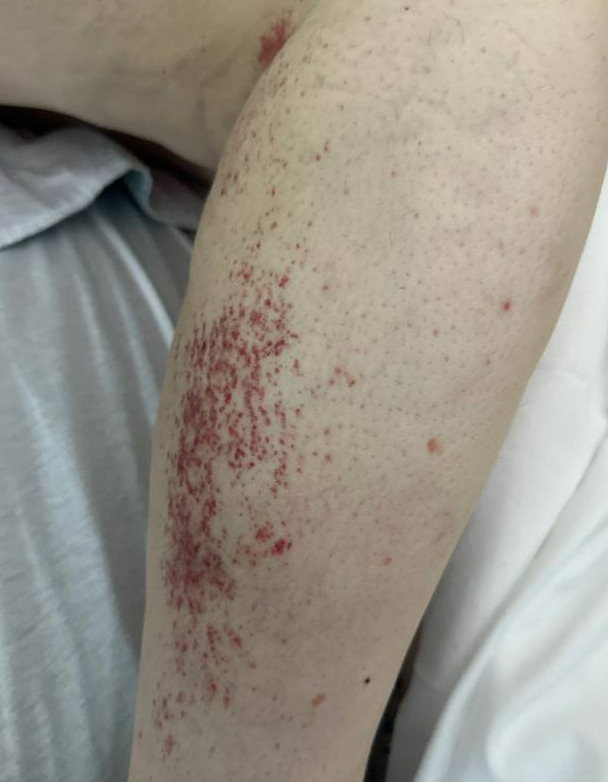
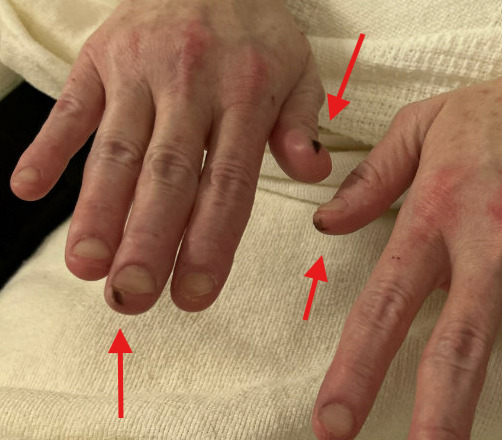
Initial evaluation revealed marked coagulopathy with an INR greater than 12, acute kidney injury (AKI), metabolic acidosis, and hypoalbuminemia. Physical examination showed no pallor or icterus. Cracked lips were consistent with angular cheilitis, and diffuse pitting edema extended to the thighs and sacrum. Dermatologic examination revealed a papular rash on the forearms and medial thighs, petechiae on the distal lower extremities (Figure 1), and an erythematous rash within the groin folds. Splitting of the skin on multiple fingertips was also noted (Figure 2). The initial differential diagnosis included a flare of a suspected or previously undiagnosed autoimmune disorder. However, inflammatory markers were within normal limits, prompting consideration of severe nutritional deficiencies secondary to chronic malabsorption as the unifying explanation for her clinical findings.
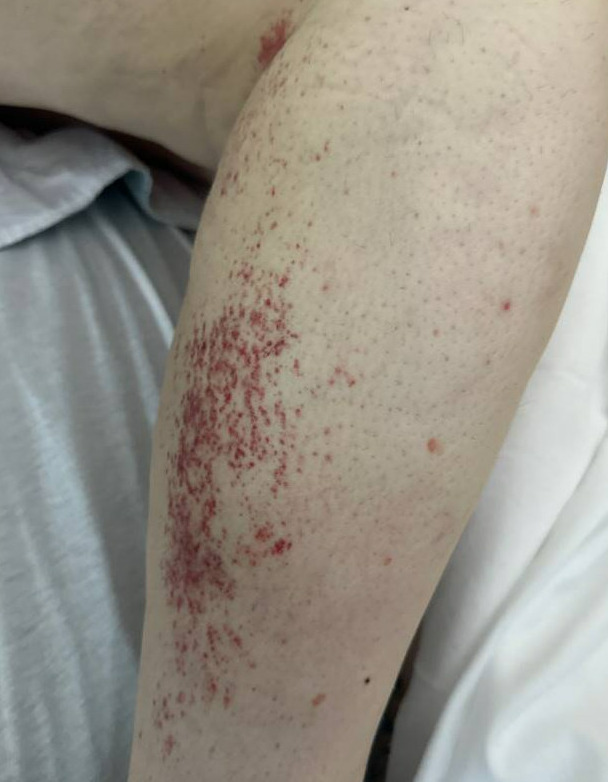
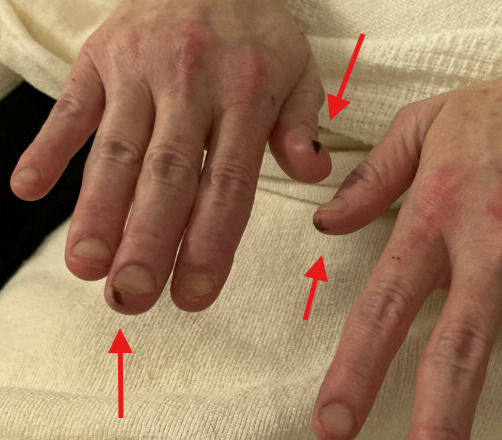
Many of the patient’s acute and subacute symptoms were attributed to the consequences of chronic malabsorption. Poor nutritional status contributed to hypoalbuminemia, resulting in intravascular volume depletion, anasarca, and prerenal acute kidney injury. Nutritional deficiencies may also have predisposed her to intertrigo and oral thrush. Vitamin K deficiency in the setting of warfarin therapy was felt to explain the profound coagulopathy. Cutaneous findings, including petechial hemorrhage, ecchymoses, fingertip fissuring, and xerosis, were consistent with nutritional deficiencies, with subsequent testing confirming severe deficiencies in vitamins C, A, and D.
Treatment was initiated with oral vitamin K, resulting in improvement of the INR to the therapeutic range, followed by initiation of a heparin infusion. A nutrition consultation was obtained, and high-dose thiamine and vitamin D, a multivitamin, and nutritional supplements were started. Topical and oral antifungal therapies were also initiated for intertrigo and oral candidiasis. As her clinical condition improved, anticoagulation was transitioned from heparin to apixaban. Apixaban peak levels were obtained four hours after the morning dose. After two doses, the apixaban level was 192 ng/mL (peak steady-state reference range, 59–302 ng/mL), and after four doses, the level was 235 ng/mL. These levels fell within the expected therapeutic range and provided evidence of adequate drug absorption, supporting continuation of apixaban after discharge.
Following discharge, fecal elastase was found to be <10 µg/g (reference range, >200 µg/g), consistent with severe pancreatic exocrine insufficiency. Pancreatic enzyme replacement therapy was subsequently initiated by her primary care physician. Repeat nutritional laboratory testing two months after discharge demonstrated substantial improvement, with all previously abnormal values approaching or returning to the reference range.
Discussion
In 2017, expert guidance recommended against the use of DOACs when therapeutic anticoagulation was indicated following bariatric surgery, favoring warfarin because of its established efficacy and ability to be routinely monitored.1 Just a few years later, the 2023 American College of Cardiology (ACC) guidelines for atrial fibrillation adopted a more permissive stance, stating that “In patients with AF who have undergone bariatric surgery, warfarin may be reasonable to choose over DOACs in view of concerns about DOAC drug absorption.”2
The optimal choice of anticoagulant following bariatric surgery therefore remains an evolving clinical question. Although there are no guidelines specifically addressing the treatment of deep vein thrombosis or pulmonary embolism in this population, and no randomized controlled trials directly comparing anticoagulant agents, emerging observational data can help inform clinical decision-making. Cohort studies have shown no significant difference in risk of thromboembolism or clinically significant bleeding between DOACs and VKAs.3–6 DOAC levels, a proxy for absorption, have varied; one study showed 91% of peak anti-Xa levels at goal, while another showed 58%.3 Another showed changed pharmacokinetics with rivaroxaban, suggesting decreased absorption.7
Different DOACs have shown different absorption, suggested to be due to their different sites of absorption in the GI tract. Apixaban, absorbed more distally in the small intestine, is less likely to be affected by surgical intervention of the proximal GI tract and has shown consistent absorption after various types of bariatric surgery.8,9 Rivaroxaban has shown variable absorption with uncertain clinical significance.7,9,10 Dabigatran has shown “probable impaired absorption”.10 Given the uncertainty in absorption, and differences between agents, the ACC guidelines for atrial fibrillation suggest monitoring DOAC levels when starting anticoagulation after bariatric surgery.2
Approximately 1 in 10 patients develop vitamin K deficiency following bariatric surgery, which can contribute to variability in vitamin K antagonist (VKA) efficacy and dosing.11 In this patient, anticoagulant selection depended not only on whether a direct oral anticoagulant (DOAC) would be adequately absorbed, but also on whether the potential risk of DOAC malabsorption outweighed the demonstrated complications of warfarin therapy. Therapeutic apixaban levels confirmed adequate absorption, supporting its use as a safer alternative to warfarin in the outpatient setting.
Conclusion
This case highlights the importance of considering nutritional deficiencies as a unifying and potentially reversible cause of coagulopathy, particularly in patients with a history of bariatric surgery and malabsorption, even when multiple competing comorbidities are present. It also demonstrates that apixaban can achieve therapeutic absorption despite severe vitamin deficiencies and chronic malabsorption related to gastric bypass and pancreatic insufficiency. Given the risk of significant coagulopathy from nutritional deficiencies in patients receiving warfarin after bariatric surgery, DOACs may represent a safer alternative, as illustrated by this patient’s therapeutic apixaban levels despite severe, chronic malabsorption.
Disclosures/Conflicts of Interest
None
Corresponding author
Daniel Walden M.D.,
Department of Internal Medicine,
Brown University, Providence, RI, USA
Email: waldendanny@gmail.com