Introduction
Advance care planning (ACP) aims to align medical care with patients’ values, and has demonstrated benefits for patient-centered outcomes, including improving goal concordant care and quality end of life communication.1,2 However, reported rates of ACP conversations in the hospital vary widely, ranging from 6% to over 20%, but overall suggest that ACP remains underutilized in this setting.3 Additionally, the effects of ACP on healthcare utilization including hospitalizations, readmissions, and length of stay, have been more mixed with effects varying by patient population, clinical setting, intervention design and outcomes measured.4–7
Delivering high-quality ACP conversations during hospitalization remains difficult due to limited time, competing clinical demands, prognostic uncertainty, and challenges in identifying which patients are most likely to benefit. To address these barriers, health systems have increasingly turned to electronic tools – including the “surprise question” (a clinician prompt asking, “Would I be surprised if this patient died within the next 12 months?”), electronic health record (EHR)–based risk models, and automated clinician notifications - to flag patients at high risk.8–10 While studies have begun to examine ACP outcomes in such algorithmically identified populations, evidence remains mixed and further work is needed to clarify how ACP influences utilization and patient-centered outcomes in this context.9,11
The quality and documentation of ACP conversations also vary considerably. In hospitals, these conversations are often unstructured, inconsistently documented, and difficult to retrieve in the EHR. Prior work suggested that structured documentation formats can improve downstream care by increasing palliative care referral, code status changes, and hospice enrollment.12,13 Structured templates may also indicate that clinicians are trained in evidence-based conversation guides, such as the Serious Illness Care Program (SICP), thereby improving both the quality and reliability of ACP documentation.14
Our study sought to extend this literature by examining structured ACP conversations in a uniquely defined population: hospitalized patients identified as high risk by two independent electronic algorithms – top quartile of predicted 12-month mortality and ≥20% predicted 30-day readmission. We selected patients meeting both criteria to identify individuals at elevated risk for serious illness and near-term healthcare utilization, who may be particularly appropriate for inpatient ACP conversations. We further focused on ACP documentation captured in a structured EHR template, distinguishing it from less reliable free-text documentation.15 We sought to evaluate the association between structured ACP documentation and hospital-based outcomes including 30-day non-elective readmission, hospital length of stay, discharge disposition, and inpatient mortality.
Methods
Data Source and Study Cohort
We conducted a retrospective study among adult patients (aged 18 and up at the time of admission) who were admitted to the Stanford General Medicine Service between January 2021 through March 2024. Patient data was identified directly from our institutional EHR, Epic Systems. This project was reviewed by the Stanford University Institutional Review Board (IRB) and was determined to be quality-improvement and exempt from IRB review. Patients were classified as high-risk if they met both of the following criteria: (1) a score in the top 25th percentile of a validated 12-month mortality prediction algorithm, and (2) an estimated >20% likelihood of 30-day readmission based on Epic’s Unplanned Readmission Risk Algorithm.9,16 The 12-month mortality prediction algorithm is a validated deep learning model that leverages routinely collected longitudinal EHR data, including diagnoses, medications, laboratory values, procedures, and healthcare utilization to estimate mortality risk. The Epic Unplanned Readmission Risk Model (version 1.0) integrates similar variables to estimate the risk of 30-day non-elective readmission. Only patients meeting both criteria were included in the final study cohort.
Exposure: Structured ACP Conversations
We defined structured ACP conversations as those documented during the index hospitalization using a structured EHR template. Structured ACP documentation was completed by clinicians trained in the Serious Illness Conversation Guide, including hospital medicine attendings, internal medicine residents, advance practice providers, and other allied health professionals.17 The 3-hour training comprised didactic and role play with standardized actors, and documentation instructions on recording structured ACP conversations in the standardized EHR template.14
Outcomes
The primary outcome was 30-day readmission, defined as whether any non-elective hospitalization occurred within 30 days of discharge from the index hospitalization. Secondary outcomes included discharge disposition (home, hospice, nursing facility). Other descriptive secondary outcomes were 30-day ICU readmission, in-hospital mortality (limited to our center), hospital length of stay (LOS) of the index hospitalization, and post-discharge mortality (analyzed as time-to-event after discharge). Post discharge mortality was identified by linking to Social Security Administration (SSA) death records, with time to death calculated from the SSA-recorded date of death.
Other Measurements
Patient demographics and clinical characteristics were collected: age (in years), gender (male vs female), race (American Indian or Alaska Native, Asian, Black or African American, Native Hawaiian or Pacific Islander, White, other, and unknown or declines to state), ethnicity (Hispanic/Latino, Non-Hispanic/Latino, and unknown or declines to state), primary language (English vs other), interpreter needed during encounter (yes vs no), case mix index (CMI, higher value suggested more complex patient case), and health insurance (private, public, and other or unknown).18
Statistical Analysis
Patients were divided into two groups based on whether they had a structured ACP conversation documented during hospitalization (ACP group) or not (No ACP group). Patient demographics and clinical characteristics were compared between groups using descriptive statistics. Counts and percentages were reported for categorical variables, mean and standard deviation (SD) for normally distributed continuous variables, and median and interquartile range (IQR) for skewed continuous variables. Univariate analyses were conducted using Two-Sample T-Test for continuous variables and Chi-Square (or Fisher’s exact) test for categorical variables. If normality assumption was invalidated, Mann-Whitney U-Test was performed for continuous variables instead. A multivariable logistic regression model was used to examine the association between ACP group and the primary outcome of unplanned 30-day readmission. A multinomial logistic regression model assessed the association between ACP group and discharge disposition. Both models adjusted for age, sex, race, ethnicity, insurance, and case mix index (CMI). Odds ratios (ORs), 95% confidence intervals (CIs), and p values were reported, with a two-sided α of 0.05 considered statistically significant. Complete case analysis was performed. All analyses were conducted using SAS 9.4 and R version 4.1.2 (ggplot2).19,20
Results
Among 20,131 patients hospitalized between January 2021 and March 2024, 14,571 were excluded, leaving 6,944 patients high risk patients in the analytic cohort. Of these, 1,166 (16.8%) had a structured ACP conversation documented (ACP group), and 5,778 (83.2%) did not (No ACP group). Baseline characteristics are summarized in Table 1. Compared with patients without ACP, those with ACP had a slightly higher case-mix index (mean 1.8 vs 1.7) and were more likely to have private insurance (26.8% vs 24.7%); race/ethnicity and interpreter use were similar between groups.
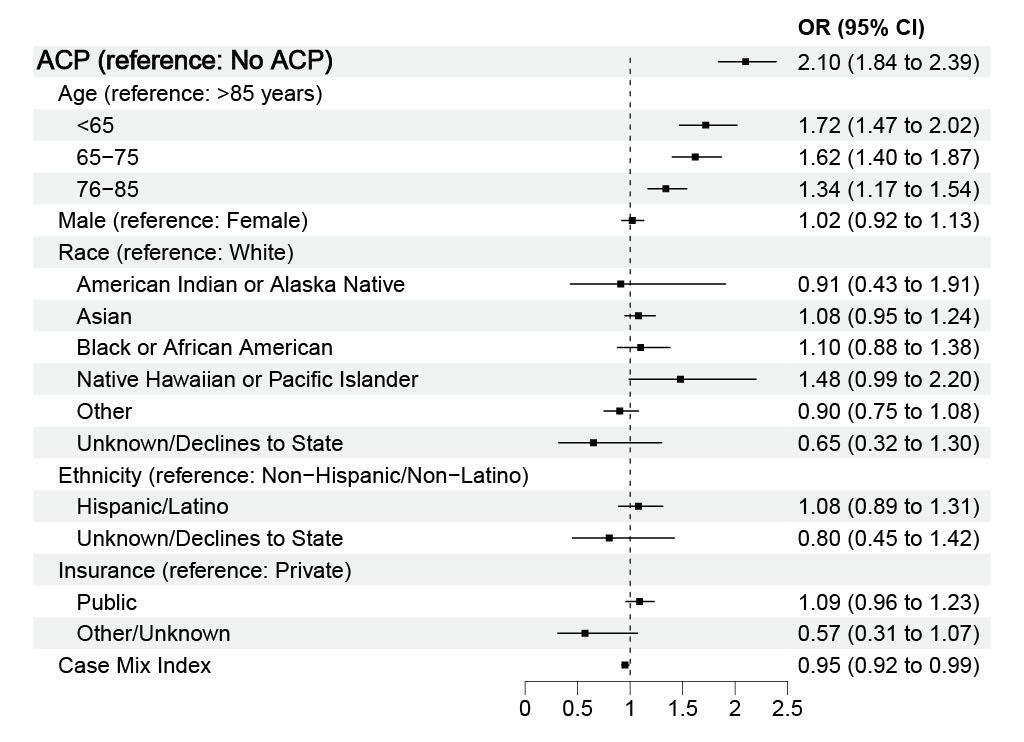
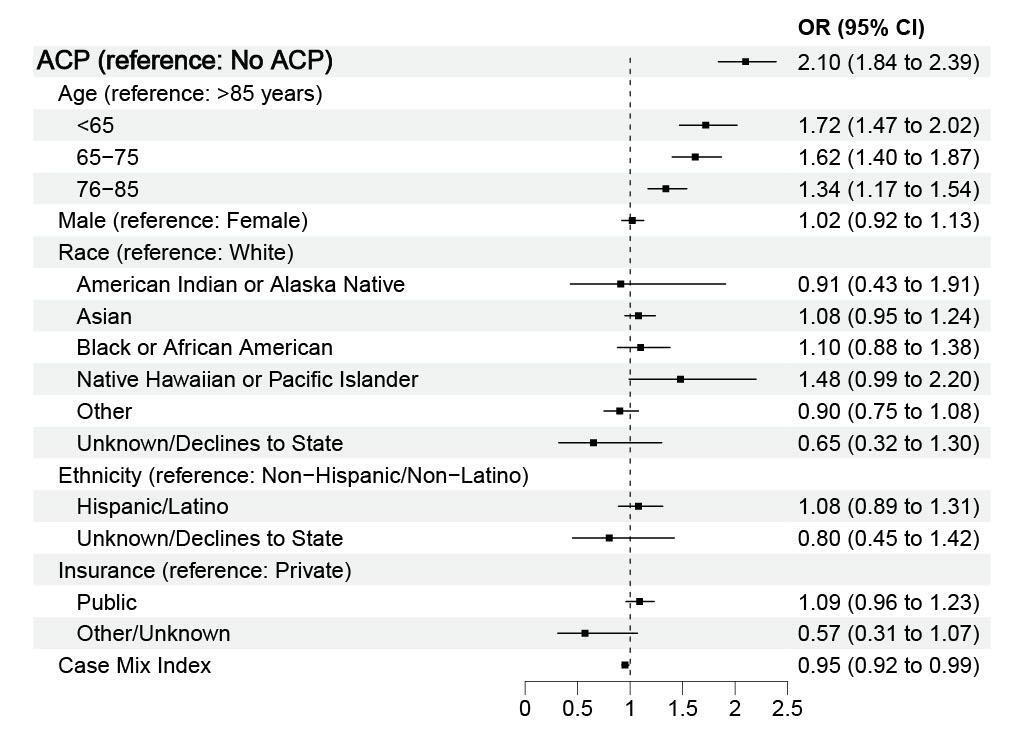
Overall, 2,335/6,944 (33.6%) patients were readmitted within 30 days. In unadjusted analyses, the ACP group had a higher readmission rate than the No ACP group (49.0% vs 30.5%; p<0.001). In multivariable logistic regression (Figure 1), structured ACP documentation was associated with higher odds of 30-day readmission (adjusted OR 2.10; 95% CI, 1.84–2.39).
In the secondary outcomes analysis, in-hospital mortality was uncommon and did not differ significantly between groups (Table 2; ACP: 3 deaths; no ACP: 22 deaths; p=0.79). Among patients who died during the index hospitalization (n=25), time from admission to death was 5.7 (SD 2.1) days in the ACP group and 8.1 (SD 7.6) days in the No ACP group. Among patients who died after discharge (n=1,438), time from discharge of index hospitalization to death was shorter in the ACP group (mean 132.8 [SD 211.6] days) than in the No ACP group (mean 159.9 [SD 199.8] days; p=0.018). Hospital length of stay during the index admission was longer for patients in the ACP group (mean 55.5 [SD 171.1] days) than for those in the No ACP group (mean 29.9 [SD 137.8] days; p<0.001). Although unadjusted results showed difference in distribution of discharge disposition comparing the ACP group vs No ACP group (Table 2), we found no statistically significant difference after adjusting for age, sex, race, ethnicity, insurance, and case mix index (CMI). Specifically, compared with No ACP, patients in the ACP group showed a trend toward higher odds of discharge to hospice (adjusted OR 1.25; 95% CI, 0.97–1.62) and lower odds of discharge to a skilled-nursing facility (adjusted OR 0.86; 95% CI, 0.73–1.01).
Discussion
In this single-center retrospective cohort of high-risk general medicine inpatients, fewer than one in five had a structured ACP conversation documented during their index hospitalization. Patients with documented ACP had more than twice the odds of 30-day readmission and substantially longer lengths of stay compared with those without documentation. While in-hospital mortality was low and did not differ between groups, ACP documentation was associated with a trend toward greater discharge to hospice and less frequent discharge to skilled nursing facilities, suggesting a potential role in disposition planning. These findings extend the literature on ACP in the inpatient setting. Prior studies have shown that structured ACP documentation remains uncommon, even among high-risk populations. Our observed rate of 16.8% is consistent with more recent reports in populations with targeted ACP initiatives but underscores ongoing barriers to broader uptake.21 Persistent challenges including limited clinician time, prognostic uncertainty, and fragmented workflows may continue to limit consistent conduct of these conversations despite clinician awareness of their importance.22
The association between ACP and higher health care utilization in this study likely reflects residual differences in patient illness severity and complexity rather than the effects of ACP itself. Compared to patients without structured ACP documentation, patients in the ACP group had higher case mix indices, longer hospitalizations, higher rates of readmission, and shorter time to death, making them more likely to undergo structured ACP conversations and experience adverse clinical outcomes independent of the conversations themselves. Because the timing of the structured ACP documentation during hospitalization was not available, we could not determine whether structured ACP conversations contributed to prolonged hospitalization or longer hospitalizations created greater opportunity for these conversations. Although our multivariable models adjusted for available demographic and clinical characteristics, residual confounding by indication likely remains. Clinicians may preferentially initiate structured ACP conversations with patients who have greater illness severity, functional decline, caregiver needs, or psychosocial complexity, factors that were not fully captured in the available data. Therefore, the observed associations between structured ACP documentation and healthcare utilization should not be interpreted as causal but may instead reflect underlying differences in patient complexity.
An additional consideration is that our exposure was structured ACP documentation rather than any ACP conversation documentation. Conversations documented in free-text notes or occurring without completion of the structured template would have been classified as no structured ACP documentation, potentially resulting in exposure misclassification. Furthermore, use of the structured template may reflect clinician documentation practices in addition to patient factors. Although adjusting for clinician or team-level documentation patterns could have addressed this variation, these data were not available. Finally, the two electronic risk algorithms used to define our study cohort should not be interpreted as comprehensive measures of patient complexity. Although they identify patients at increased predicted mortality and readmission risk, they do not fully capture functional status, caregiver availability, social supports, frailty, or other aspects that contribute to overall patient complexity. These unmeasured factors may have influenced both the likelihood of structured ACP documentation and subsequent healthcare utilization.
Prior interventional studies have reported mixed effects: some demonstrated reductions in intensive treatments following ACP, while others found no change - or even increases - in subsequent health care use.2,11,23 Two explanations may account for our findings. First, ACP documentation may serve as a marker of patient complexity and illness severity. Clinicians may be more likely to initiate structured ACP conversations with sicker or frailer patients who are inherently at higher risk for rehospitalization, which could explain the longer hospital stays and higher readmission in the ACP group. An alternative explanation is that prolonged hospitalization provides additional opportunities for goals-of-care conversations, and clinicians may initiate these discussions to support discharge planning and ensure alignment with patient values. While CMI adjustment in our model helped account for differences in severity and complexity between ACP and No ACP cases, residual confounding likely persists, suggesting that ACP patients may have distinct complexities not fully captured by CMI.24 Second, structured ACP conversations may increase patient and caregiver engagement with the health system. By clarifying symptoms to monitor, providing explicit follow-up plans, and encouraging earlier contact when problems arise, ACP may offer more touchpoints for health care use or encourage earlier recontact when concerns arise. Together, these interpretations highlight that ACP is unlikely to operate as a simple utilization-reducing intervention, but instead reflects a complex interaction between patient needs, clinician judgment, and health system responses.
Our observed trends in discharge disposition with greater hospice use and less skilled nursing facility placement in the ACP group supports the role of these conversations in shaping goal-concordant discharge planning. Even though these differences did not reach statistical significance, they are consistent with prior studies showing that ACP may facilitate more values aligned discharge planning and earlier hospice involvement.25,26 Although there were no differences in in-hospital mortality between the two groups, there were 22 in-hospital deaths in the No ACP group. Because our study specifically examined the documentation of structured ACP conversations, we surmise that these patients may have had rapidly progressive illnesses where unstructured, ad hoc goals-of-care discussions were conducted around specific therapies (i.e.. comfort focused measures) and there was less opportunity for deliberative conversations.
Several limitations warrant consideration. First, this was a retrospective study from a single academic center, limiting generalizability. Second, ACP documentation was defined strictly as documentation in a structured EHR template; conversations documented elsewhere or not recorded at all were not captured, leading to potential misclassification and documentation bias. Prior studies have demonstrated that ACP documentation is often inconsistent and difficult to locate in the medical record.27 We were also unable to assess the quality or fidelity of structured ACP conversations. Third, we were unable to measure readmissions that occurred outside our health system. Fourth, we focused on 30-day outcomes; longer-term endpoints such as 6- or 12-month mortality, quality of end-of-life care, or patient-reported outcomes were not assessed. Finally, the study period overlapped with the COVID-19 pandemic, when hospitalization patterns, clinical workflows, discharge practices, and healthcare utilization may have differed from those in non-pandemic settings, potentially limiting generalizability.
Despite these limitations, our study highlights several implications for hospital medicine. A structured ACP conversation during hospitalization alone was not associated with lower short-term healthcare utilization in this high-risk population, who often have complex needs requiring robust transitional support. These findings should not be interpreted as evidence that ACP is ineffective, as we did not measure the number, timing, or quality of ACP conversations and cannot infer causal effects. Moving forward, hospitals may benefit from embedding ACP within bundled care strategies that link high-risk identification to ACP conversations, automatic palliative care referral, and coordinated post-discharge planning. In parallel, improving the fidelity of ACP documentation could provide a more accurate understanding of ACP delivery and its impact. Equally important, ensuring that the outcomes of inpatient ACP discussions are communicated and reinforced in the outpatient setting, or coupled with hospice and palliative care services, may be necessary to influence longer-term, patient-centered outcomes.
Disclosures/Conflicts of Interest
Winifred Teuteberg provides consulting for Ariadne Labs.
Corresponding Author
Samantha XY Wang, MD MHS
Division of Hospital Medicine,
Department of Medicine, Stanford School of Medicine, Stanford, CA, USA
Email: wangxy@stanford.edu