Background
Effective communication between healthcare providers and patients is crucial for shared decision-making and informed consent.1 For patients with hearing loss, hospitalization can present challenges to effective communication, including ambient noise, illness acuity, and inhibition of lip reading from face masks. While federal laws have sought to ensure effective communication for non-English-speaking patients and deaf patients who use American Sign Language (ASL),2,3 patients with hearing impairment often report limited access to auxiliary hearing devices or formal accommodations, highlighting a gap in health equity for this population.4
Despite patient rights policies,5 hospitals often lack standardized systems to identify, document, and support hearing-impaired inpatients. The literature on appropriate capture of hearing impairment documentation in the electronic health record (EHR) shows that hearing impairment is documented unreliably.6–8 A recent study of newly admitted patients aged 70 and older found a high prevalence of hearing impairment (72.8%), yet routine admission procedures had low sensitivity (14% to 43%) for identifying hearing impairment.9
Additionally, the availability and use of personal hearing amplifiers (PHAs), augmentation devices for hearing-impaired patients with presbycusis in the hospital setting, are scantily reported in the literature, suggesting a need for greater accessibility10–12 Quantitative research studies on adverse outcomes in hearing-impaired hospitalized patients demonstrate that hearing impairment has been associated with a variety of harms, including hospitalization, readmission, falls, and surgical complications.13–17 These findings underscore the need for systematic identification and support strategies for hearing-impaired patients during hospitalization.
Despite this growing body of evidence, our own institution, like many others, lacks a standardized approach for identifying, screening, or documenting hearing impairment in the EHR. Although PHAs are technically available, inconsistent provider awareness and limited distribution hours restrict their use. Importantly, the extent to which hearing impairment affects communication during hospitalization at our institution, and where breakdowns most commonly occur, remains unknown. Therefore, this study aimed to investigate and characterize provider-perceived challenges in communicating with hearing-impaired hospitalized patients and to describe how hearing impairment is currently documented in the EHR. By defining the scope and nature of these barriers within our local clinical infrastructure, we aim to identify opportunities to improve identification and support for patients with hearing-related communication needs.
Methods
To better understand provider perceptions of the current state of the care of inpatients with hearing impairment, we conducted a small anonymized electronic convenience survey of 34 healthcare professionals (30 MDs/Advanced Practice Providers and 4 nurses) who provide care in our Department of Medicine services regarding their perceptions of barriers to care for hospitalized patients with hearing impairment. We created and tested an initial pilot survey among hospitalist providers. Based on feedback, we adjusted the survey and distributed it. The distribution coincided with the COVID-19 pandemic.
We assessed the documentation of any type or severity of hearing impairment in the EHR using a structured query to evaluate its availability and utility for healthcare providers caring for this vulnerable population. We examined inconsistencies in documentation and identification of hearing impairment by reviewing the EHRs of patients aged 65 years and older discharged from the Medicine, Geriatrics, and Surgery services at University of North Carolina (UNC) Hospitals between June 1, 2023, and June 1, 2024. Table 1 outlines the EHR locations reviewed for evidence of hearing impairment. For each patient with documented hearing impairment, we calculated descriptive statistics on the EHR locations where it was documented.
We used univariable and multivariable logistic regression to examine associations between demographic and clinical variables and documentation of hearing impairment in the electronic health record (EHR). All demographic variables were included a priori in the multivariable model. We also included clinical variables with p < .20 in univariable analysis, consistent with established practices for variable selection in exploratory regression modeling. No data were missing for any variable included in the analysis. We assessed collinearity among covariates using variance inflation factors (VIF), with a threshold of VIF > 5 to identify problematic collinearity. No collinearity exceeding this threshold was identified. Model fit was evaluated using the Hosmer–Lemeshow goodness-of-fit test. All analyses were conducted using Stata 15.3.1 (StataCorp, College Station, TX). The UNC School of Medicine Institutional Review Board reviewed this study (#22-2815) and deemed it exempt.
Results
Provider Survey Results
Survey response rate was 100%. Survey responses show that providers are often unaware their patients are hearing impaired based on EHR documentation, with 97.1% saying they never or only sometimes know their patients are hearing impaired after reviewing the EHR (Table 2). Additionally, over 76% of providers strongly disagreed with the statement, 'I am satisfied with communication with patients with hearing loss hospitalized at UNC medical center, and 60.6% find the additional workload, in the current clinical setting, of caring for patients with hearing impairment burdensome. When hearing-impaired patients require PHAs, about 70% of providers report difficulty accessing PHAs in the inpatient setting (Table 2). Other challenges providers noted include that inpatients are often without their personal hearing aids, and when they are available, they often do not function well.
Analysis of EHR Documentation of Hearing Impairment
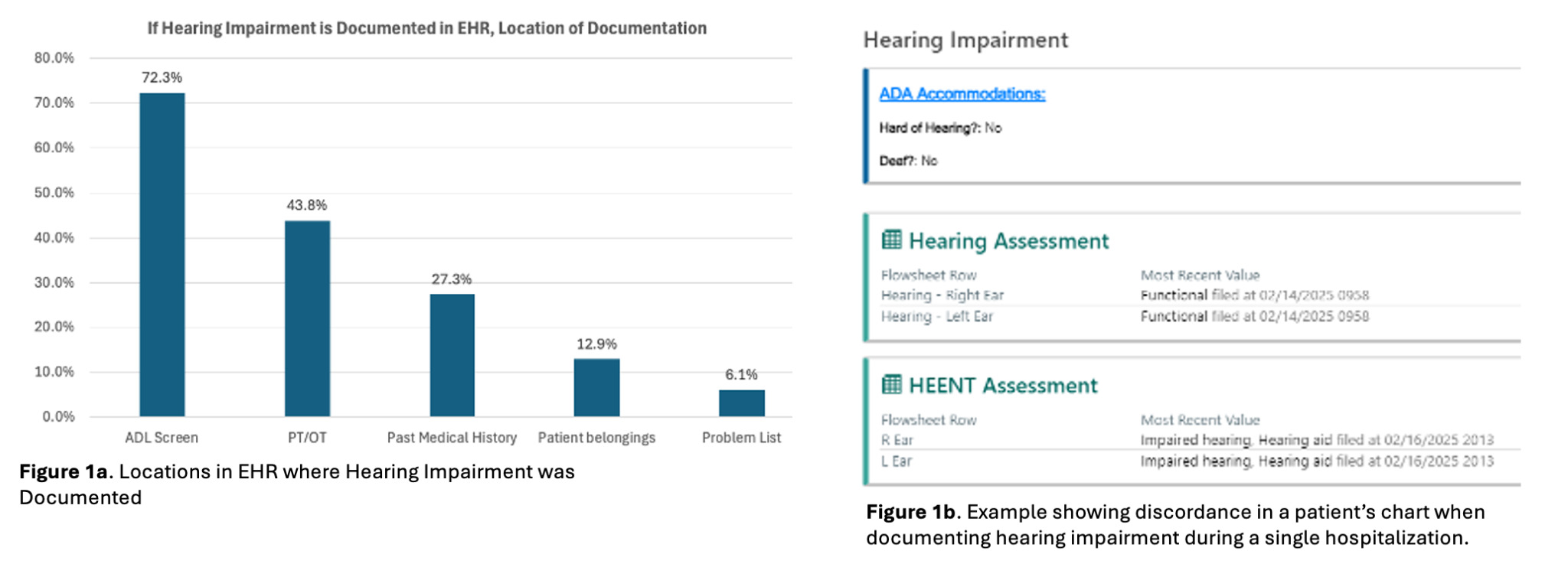
During the study period, there were 7,481 unique hospitalization encounters. The mean age was 76 years; approximately 49% were women, 70.4% were white, and 3.7% were non-English speakers. Most patients were on medicine services (62.9%), with the remainder on surgery (27.0%) and geriatrics (10.1%) services. Overall, 31.4% of patients had at least one instance of documented hearing impairment in the EHR (n=2008). The mean length of stay was 8.4 ± 11.2 days, with a median of 5 days (1–228 days). Nursing assessments, via the activities of daily living (ADL) screen, are the most frequent source of hearing impairment documentation in the EMR. Figure 1a shows the breakdown by location.
_locations_in_ehr_where_hearing_impairment_was_documented._(b)_example_showing_discorda.png)
In multivariable analysis (Table 3), patient age (OR: 1.11, p < 0.001), white race (OR: 1.82, p < 0.001), and being hospitalized on the Geriatrics service (OR: 1.31, p = 0.003) were associated with increased documentation of hearing impairment in the EHR. Female gender (OR: 0.58, p < 0.001) was associated with reduced documentation of hearing impairment in the EHR. Documentation of hearing impairment did not differ between non-English speakers and English-speaking patients. Documentation also did not differ significantly across hospital services, except in Geriatrics (p=0.003).
Variability in EHR Documentation of Hearing Impairment
We identified limited concordance in EHR documentation of hearing impairment (Table 4). Agreement between EHR locations was poor to fair by kappa statistic, with the highest observed between physical therapy/occupational therapy (PT/OT) and ADL screens (κ = 0.371) and lower values between structured problem-oriented sections and screening flowsheets (e.g., ADL vs Problem List κ = 0.088; PT/OT vs Problem List κ = 0.123). Among patients who screened positive for hearing impairment during inpatient PT/OT assessments, approximately 40% had no corresponding documentation of hearing impairment in any other section of the EHR, including locations where such information is more commonly recorded (such as ADL).
Additionally, standardized nomenclature was absent across disparate parts of the medical record. Nursing assessments include a mandatory hearing screen as part of the ADL flowsheet, which categorizes hearing status into only four options: difficulty with noise, hearing aid, deaf, or cochlear implant (Table 5a). In contrast, PT/OT assessments use broader categories, including hearing impairment, mild impairment, severe impairment, hearing aid, and delayed auditory processing. The terminology applied in the Past Medical History and Problem List sections differs from both the ADL and PT/OT documentation (Table 5). As reflected in the low kappa values (Table 4), substantial variability and a lack of congruence in how hearing impairment is documented across EHR sections remain.
Discussion
Effective communication in the hospital setting is paramount for safe, high-quality care and informed decision-making. For patients with hearing loss, environmental barriers often compromise communication. Despite federal mandates and institutional policies supporting communication access, our findings highlight critical deficiencies in both identifying hearing impairment and providing appropriate accommodations during hospitalization.
In this study, we found that fewer than one-third of hospitalized patients aged 65 and older had any documentation of hearing impairment in the EHR, despite national data suggesting much higher prevalence. It is estimated that about 50% of older adults over 75 have disabling hearing loss.18 Importantly, approximately 75% of hearing impairment remains undiagnosed and untreated.19,20 Among hospitalized Medicare beneficiaries, 11.6% reported that hearing impairment impeded communication with clinicians; patients reporting these difficulties were 32% more likely than others to be readmitted.13 These statistics reinforce the clinical and health system relevance of hearing impairment and underscore a persistent equity gap in care delivery for older adults with hearing loss.
Our study showed that EHR documentation was heavily nurse-driven, with the nursing ADL screen providing the largest source of hearing impairment documentation. Unfortunately, the ADL screen is deeply embedded in the EHR and difficult to access, so it is often overlooked. Unless other team members seek out and actively add or reconcile this information into the main medical record, providers may remain unaware of patients’ hearing impairment documentation. Additionally, nursing documentation uses different qualitative categories (e.g., difficulty with noise, hearing aid, deaf, cochlear implant) that do not align with PT/OT assessment nomenclature and are distinct from the sections in the past medical history and the problem list. Nearly 40% of patients identified as hearing impaired by PT/OT had no corresponding documentation elsewhere in any EHR section. In universally accessible sections of the EHR across all visit types and providers, such as past medical history and the problem list, hearing impairment was found in these locations only 27% and 6% of the time, respectively. This fragmentation and inconsistent nomenclature mirror prior findings in the literature, which demonstrate that hearing impairment is documented in a variety of locations without congruence.6–8
The absence of standardized nomenclature and structured workflows limits providers’ ability to quickly identify patients with communication needs. Nearly all providers surveyed reported they rarely recognized hearing impairment when reviewing the EHR before entering a patient’s room, and over one-third reported difficulty locating this information. Over three-quarters expressed dissatisfaction with communication during inpatient care, while the majority cited difficulty locating documentation in the EHR and difficulty obtaining PHAs.
System-level barriers further impede hearing accommodations. Although personal hearing amplifiers are available, nearly 70% of providers reported that obtaining PHAs in the hospital was difficult because of non-centralized storage and limited office hours. Additionally, unlike EHR translator flags, no EHR flag indicates whether PHAs are needed for patient communication due to the severity of hearing loss. Furthermore, a 2023 study found that about 40% of patients with hearing impairment do not use their PHAs during hospitalization, often because of concerns about device loss and high replacement costs.21
A recent outpatient survey noted that when PHAs are not used, clinicians may rely on informal strategies such as speaking louder or slower, which patients have described as ineffective and privacy-breaching.4 Although guidelines and best practices for communication in patients with hearing impairment are published in the medical literature and online resources,22,23 the absence of PHAs limits clinicians’ ability to proactively provide communication support and likely contributes to missed opportunities to improve patient experience and outcomes. Additionally, providers may also rely on family members to help communicate with patients with hearing impairment rather than speaking directly to the patient, and patients may be less involved in shared decision-making.
Overall, our findings reflect a systemic lack of awareness, infrastructure, and training to support hearing-related communication needs. This omission perpetuates the marginalization of hearing impairment in health care delivery and policy. Despite the well-documented impact of hearing impairment on patient outcomes, studies of physician-patient communication rarely address it. Given the high prevalence of hearing impairment among hospitalized older adults and its association with adverse outcomes, including increased risk of readmission, falls, and surgical complications, standardized, system-level solutions are needed.24–27
Our study had several limitations. Currently, no universally accepted ‘gold standard’ exists to verify the accuracy of hearing impairment documentation in the EHR. This study highlights significant inconsistencies in where and how hearing impairment is recorded. However, the lack of standardization makes it challenging to determine the true prevalence of hearing impairment in hospitalized patients. This limits the ability to assess the reliability of the recorded data and also likely underestimates the true prevalence of hearing impairment in our study. The small survey sample of 34 providers and nurses, which yields exploratory observations, limits generalizability. The COVID-19 pandemic also interrupted the study and inadvertently limited survey access for nursing staff. The study focused on provider perceptions and EHR documentation rather than directly assessing patient experiences, preferences, or challenges. Unmeasured confounders such as provider awareness, training, or implicit bias may influence associations between documentation and demographic factors. Notably, the multivariable model characterizes factors associated with documentation of hearing impairment, not confirmed hearing impairment. Given the absence of a gold-standard reference, the observed associations with age, race, gender, and service line may reflect differences in screening practices, provider awareness, implicit bias, or documentation habits rather than true differences in the prevalence of hearing loss. These findings may reflect documentation behavior and potential equity gaps in identification, not epidemiologic estimates of who is hearing impaired. The study was conducted at a single large academic medical center using a single vendor EHR (Epic). The specific locations where hearing impairment was captured (Figure 1b) and the degree of discordance among them (Table 4) may reflect local EHR use. Community hospitals and smaller systems may differ further, pending standards for nursing screening and the routine use of PT/OT. However, some of the core problems identified- reliance on nurse-driven screening, non-standardized nomenclature across sections, poor concordance, and lack of an accessibility flag analogous to language flags are structural features common to many EHRs and align with prior multi-institutional findings,6–8 suggesting that the themes are potentially broadly relevant.
Despite these limitations, our findings identify multiple opportunities for quality improvement. Standardized screening and harmonized EHR documentation are needed to ensure hearing impairment is consistently identified and readily accessible to providers. Reliance on nursing documentation alone is insufficient; structured fields or EHR flags could be incorporated across disciplines to improve visibility. Improving availability and accessibility of PHAs, along with staff training in effective communication strategies, represents additional system-level solutions. Other considerations could include EHR-based accessibility questionnaires or the standardized collection of disability status during registration.28,29 Further study is also needed to assess the experiences of patients with hearing loss, including satisfaction with the use of PHAs and preferences for accommodations across different disciplines. Such interventions could help close a persistent equity gap and improve safety, patient experience, and outcomes for hospitalized older adults with hearing loss.
Disclosures/Conflicts of Interest
None
Corresponding author
Escher L Howard-Williams. MD
Associate Professor of Medicine, Division of Hospital Medicine,
Department of Medicine University of North Carolina School of Medicine
101 Manning Drive, CB #7085 Chapel Hill, NC 27599
Email: escher_howard-williams@med.unc.edu