Background
Hospitalists and internal medicine physicians play a critical role in providing high-quality hospital care. One metric hospitals and clinicians use to measure quality and efficiency of care is length of stay (LOS), defined as the time elapsed from admission to discharge. LOS has been tracked almost as long as hospitals have existed—New York Hospital monitored LOS as early as 1793, but the importance of this metric has evolved over time, particularly as hospitals strive to improve efficiency. In the United States, Medicare reimburses hospitals for patient cases based on diagnosis-related groups (DRGs) regardless of LOS, incentivizing shorter lengths of stay and effective resource allocation.1 Prolonged hospital stays with unnecessary days are detrimental to patients due to increased cost burden and risk of hospital-acquired infections.2,3 Higher LOS and discharge delays can negatively affect hospital resource utilization, with downstream effects such as increased mortality.4
Whether physicians’ clinical experience, measured by years since medical licensure, is associated with length of stay (LOS) remains unclear. A recent systematic review found no consistent association between physician experience and healthcare quality.5 However, for safety-related outcome measures, surgeons’ clinical experience was positively associated with safer care.5 Another systematic review found that hospitalist care led to shorter LOS and lower cost per stay, as well as improved care for orthopedic surgery patients and patients with pneumonia and heart failure.6 This review summarizes the existing literature on the effects of physician clinical experience on LOS, particularly among hospitalists and inpatient internal medicine and pediatric physicians.
Methods
The search methodology was designed based in part on methods used by Ajmi & Asae.5 A test search, followed by a review of initial articles, revealed high-yield phrases used to capture and describe physician clinical experience. We used these terms to create a search string combining common ways of describing physician clinical experience with the Boolean operator “OR,” and completed with “AND” “length of stay.” Using PubMed as our database, we searched the terms “physician age” OR “physician clinical experience” OR “physicians’ clinical experience” OR “years of experience” OR “years’ experience” OR “level of experience” OR “clinician experience” OR “consultant experience” OR “years in practice” OR “clinical experience” AND “length of stay.”
Further selection was based on specialty. We included articles on medical and pediatric specialties in both academic and non-academic inpatient settings, and excluded those on surgical specialties. We included articles with physicians as subjects and excluded those focused on nursing or advanced practice providers. Finally, we removed articles that did not include LOS as a quality metric or that did not measure physician clinical experience quantitatively. We reviewed the selected studies in depth to identify the reported effect of experience on LOS. We also reviewed the methods used to measure physician clinical experience and other major results. We excluded studies that did not measure physician clinical experience in years since graduation, licensure, or residency. We also noted each study’s practice context (e.g., country of practice, number of patients, teaching status).
Results
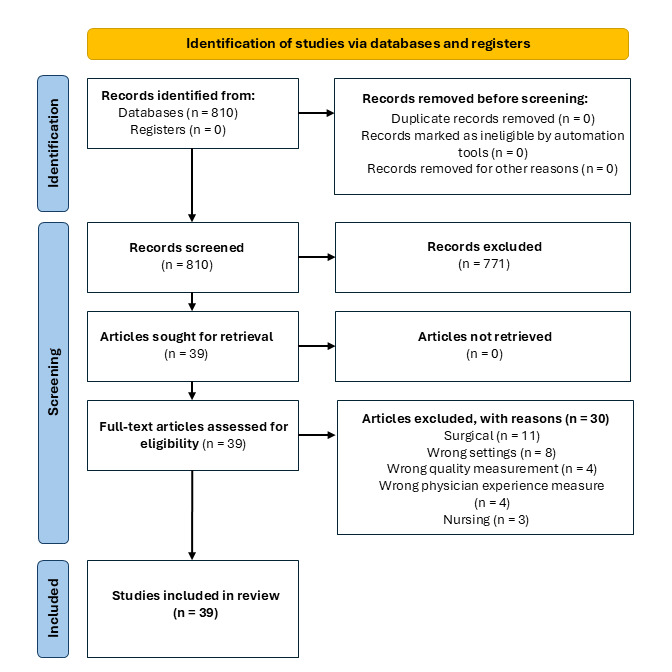
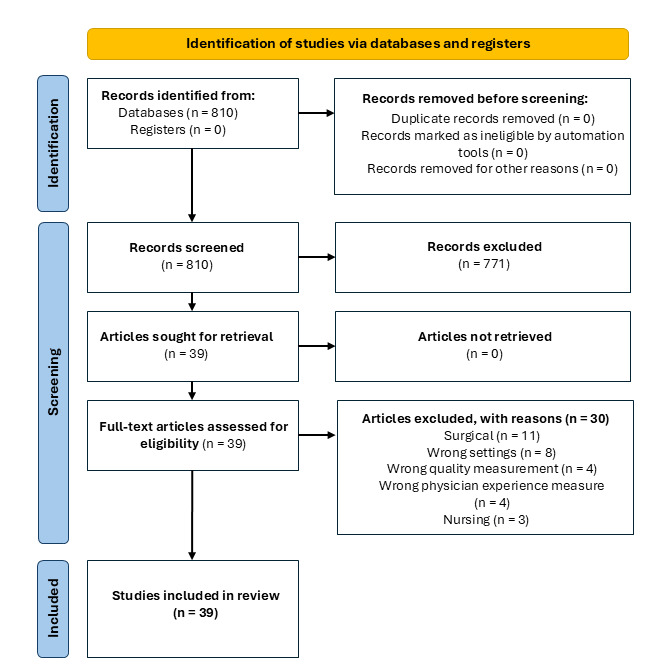
The initial search identified 810 articles (see Figure 1 for PRISMA flow chart).7 After review, we identified nine studies encompassing 180,455 patient encounters across three countries with different healthcare systems (Table 1). Physician clinical experience was most commonly measured as time in years since medical school graduation, residency completion, or licensure.
Four of the nine included studies (44.4%) demonstrated shorter LOS among patients cared for by more experienced physicians, while two studies (15.4%) found longer LOS associated with greater physician clinical experience. Three studies (33.3%) reported no significant association.
Three of the four studies associating increased physician clinical experience with shorter LOS took place in Ireland at a single institution.8–10 In a large study including 19,295 patients over four years, patients cared for by physicians with more than 20 years of experience had a statistically significant reduction in LOS (5.2 vs 5.7 days; p = 0.001).8 Similarly, two additional studies demonstrated shorter LOS among high-risk patients managed by physicians with greater than 20 years of experience, particularly among those with high patient volumes.9,10 In the United States, Burden et al. found that each year since training was associated with a 0.7% decrease in LOS when analyzing 4,189 patients at three US academic hospitals.11
Conversely, two studies (one in the United States12 and one in Canada13) reported longer LOS with increased physician clinical experience. Among physicians caring for high patient volumes in the US study, mean LOS was 4.77 days for those in their first 5 years of practice compared with 5.31 days for those with over 20 years’ experience (p = 0.001).12 In a general internal medicine teaching service in Canada, McAlister et al. found that mean LOS was longest among physicians in the highest quartile of experience (>23 years; p < 0.001).13 However, after adjusting for intra-physician clustering, the mean adjusted LOS did not differ between the most and least experienced physician quartiles (7.90 [95% CI 7.39–8.42] vs 7.63 [95% CI 7.13–8.14] days; p = 0.90).13
Three United States studies found no statistically significant differences in LOS across levels of physician clinical experience. In a pediatric study comparing general pediatricians to hospitalists, mean LOS (4.7 versus 4.6 days) was similar with adjustments for physician characteristics.14 Another study compared patient outcomes between attendings on direct care teams against attendings on teaching teams (with an average of 1.7 years and 16 years of experience post-residency, respectively) at a single Pittsburg pediatric hospital.15 The direct care team attendings had shorter LOS by 0.5 days (3.02 days ± 2.18 compared to 3.52 days ± 5.09), but this did not reach a level of statistical significance. Finally, no significant correlation was found between LOS and the number of years since attending physicians completed residency or number of days on service during the academic year in a study of attendings in a large academic center in Iowa.16
Discussion
In this review, the effect of physician clinical experience on LOS was inconclusive, though the plurality of identified studies found greater years of experience associated with shorter LOS. Multiple explanations may underlie this association, including improved knowledge, stronger leadership skills, or better navigation of the healthcare system.9 Conversely, three studies found no association, and two found a negative association between years of physician clinical experience and LOS. Several potential individual-level mechanisms for a negative effect might exist, such as increased rates of burnout,12decay of clinical knowledge gained from training, or failure to maintain up-to-date practice standards.17
We noted many differences in methodologies and practice contexts between studies. Determinants of LOS are complex, and many factors outside physician clinical experience could account for variation between providers. For example, several studies evaluated the interaction of case mix and illness severity with experience and LOS. In one study at a Canadian academic center, the negative effects of experience on LOS were attenuated when adjusted for patient case mix.13 Variables like patient case mix and illness severity may thus play a larger role in determining LOS than individual factors like physician clinical experience. Associations may also depend on how experience is measured. The most common definition of physician clinical experience used was time elapsed since medical licensure. In contrast to measuring experience starting after medical school graduation, clinical experience gained after licensure may better represent the type of clinical exposure needed to affect inpatient-specific outcomes. For example, a physician with four years of experience after medical school likely represents a new attending physician whose focus may be mostly on refining their practice style. However, a physician with four years of post-licensure experience has likely had 2-3 years of dedicated inpatient practice, allowing for more concentrated skill development in hospital medicine that could contribute to reduced LOS. Additionally, some studies included attendings on teaching teams with a mix of trainees (medical students, interns, and senior residents), whereas other studies included non-teaching teams with only an attending physician. Learner performance on a team may influence LOS, independent of the attending physician’s performance.
Several limitations warrant consideration in this scoping review. First, as noted above, we observed significant heterogeneity in the study designs, clinical settings, patient populations, and measures of physician clinical experience. This methodological variability limits our ability to directly compare findings across studies and precludes drawing definitive conclusions about the association between physician clinical experience and LOS. Furthermore, because this was not a systematic review, we did not estimate a pooled effect size or formally assess the strength of evidence across studies.
The results of this review also highlight several potential areas of future investigation. It is possible that an optimal range of experience exists, or that there is a sweet spot, such as among mid-career physicians, who may balance the efficiency and confidence gained through years of practice with the up-to-date knowledge and skills acquired during formal training. Additional factors, including cumulative case volume, familiarity with hospital systems, and sustained engagement in mentorship or feedback processes, may also contribute to variations in physician performance and, ultimately, patient outcomes. The mechanisms by which physician clinical experience affects LOS remain unclear. Future research should incorporate more standardized definitions of experience, adjust for case complexity, and explore process-level factors, such as interprofessional coordination and discharge planning, that may mediate the relationship between clinical experience and LOS. Understanding these dynamics will be critical for optimizing hospital efficiency while maintaining high standards of patient care. Future studies could also explore which specific aspects of experience contribute most to the variation in LOS (i.e., overall knowledge, case-specific experience, improved care navigation and resource utilization, etc.). Additionally, future investigations might seek to determine how practice context modifies the relationship between LOS and experience. For example, future studies may examine differences between countries where insurance practices and medical education and training may influence the relationship.
Conclusion
While physician clinical experience has been shown to influence patient outcomes, including hospital LOS, the relationship remains unclear, in part due to heterogeneity across existing studies. Collectively, the evidence suggests that physician clinical experience alone is not a consistent determinant of LOS. Further research is needed to elucidate the mechanisms through which clinical experience may shape patient outcomes.
Disclosures/Conflicts of Interest
The authors have no conflicts of interest to declare.
Corresponding author
Alexandra Arges MD
Division of Hospital Medicine
Emory University School of Medicine
Email: aarges@emory.edu